
Wednesday, March 4, 2015
rotting heartwood but a real beauty to behold


Wednesday, January 18, 2012
the golden boy
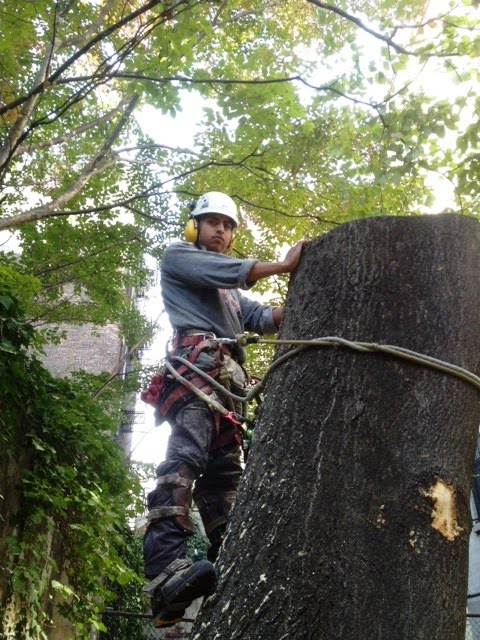 davi ariza began working on the ground with us the day after arriving here in the states sometime in january of 08'. as a beginner on the crew, all he did was drag brush and cleanup. but he was always watching. his father was a climber for me at the time. i had no idea how intently he had been watching until the first time i saw him up in a tree. we had to get deadwood out from a huge monstrosity of an oak tree and when i got back to the job davi was all the way out at the tip of a huge 35' foot long lower limb sawing off dead wood. wow....his movements seemed awfully familiar. then it dawned on me. in the summer past we had scott forest and james kilpatrick working with us. davi had obviously been watching these guys and had internalized the imagery. coupled with the fact that davi has a natural predisposition for tree climbing his evolution as a tree climber has been just amazing.
 Tuesday, November 9, 2010


Monday, January 25, 2010
Yugi Yoshimura
 now in retrospect, i can't believe the amazingly good fortune i had, to have worked at the New York Botanical Garden when i did. i was surrounded by people who were the top in there respective fields. Some, the leading authorities in the world!! i remember asking Arthur Cronquist questions about botany!! That was like being able to ask Babe Ruth about playing baseball. if i had questions about ferns i could ask John Mickel!! I had the NYBG library to peruse at lunchtime and after work. It was unbelievable the resources i had while at NYBG. At the time, and still today, i was madly interested in pruning miniature trees, Bonsai. I took Yugi Yoshimura's classes at NYBG and realized that he knew. He knew how to do that thing that would make miniature trees hold poses like still photographs of dancers in mid step. and i couldn't get enough of him. i attended presentations and lectures he gave at NYBG, took all his classes. joined the bonsai society where he would give demonstrations. i would stop to chat and ask questions whenever i ran into him on the grounds or at the conservatory. i often wondered if he thought i was stalking him. Apparently not, he seemed very pleased by my enthusiasim and was as excited to share his knowledge as i was to seek it. Yugi was one of the first bonsai masters to introduce bonsai to the united states back in the 1950's. He passed on in 1997. While going thru my older bonsai books about a year ago, i found this post it stuck onto the first page of John Nakas bonsai techniques volume one. It has a lot of meaning for me and so i framed it. Its a note Yugi gave me stuck onto an article in the New York Times he wanted me to read.
Monday, January 18, 2010
Bob Weber- Bob the tree god
 Bob Weber is in the middle, Chris Roddick to the left, and me. this picture was taken in 1997 judging by the date stamp in the bottom right corner. The year before i had gone down to North Carolina to work in the cleanup of hurricane fran. Bob had organized a bunch of climbers from around the country to lead 4-man tree crews. each crew had a climber, skid steer operator, crane operator, ground guy, and a monitor from the army corp of engineers. this was one of my favorite experiences doing tree work. it was like going away to war for tree climbers. we would travel from town to town encountering horrific tree disasters. tall pine trees half uprooted towering precariously over peoples homes. multiple trees piled on top of homes. all the fallen trees under tension. one wrong cut and your saw would get pinched or worse yet you would unleash a log under tension , which is the equivalent of playing with dynamite. situation after situation of the tree removal scenarios usually encountered only once or twice a year. 2 0r 3 a day, day after day. we would work from morning till night, no days off. 7 days a week. staying in dinky little motels. we would all meet after work to eat and exchange war stories. i had never worked with cranes before and a lot of what i was doing was the first time. i was excited as hell, like a kid at camp. for Bob, all the complicated rigging scenarios were just business as usual. people began refering to "Bob the tree god".
Travis Wolf/brooklyn botanic garden conservatory
 Travis Wolf pruning indoors at Brooklyn Botanic Garden Conservatory. Travis works with my pal Chris Roddick at BBG. they are the two staff arborists there.
Sunday, January 3, 2010
Erwin Vermuyten/tree work in New York city
 just about every year or so i get the privilege of hosting a climber from overseas. usually they are here for the tree climbing competitions. every one so far has been an inspiring and fortunate experience. this last year was no exception. Erwin was the Belgium chapter champion for 2009 and our mutual pal Bob Weber arranged for us to meet at the competition being held in Rhode island. Erwin stayed with me for a few weeks to work and check out New York. went out to the west coast to travel up route one and see the giant trees over there. came back for another week or so. I have yet to meet a tree climber from overseas who wasn't just fantastic to spend time with. Erwin was such a great person. then of course, there was all the brilliant ideas and techniques he shared with me. as well, rather isolated as i am here in the states doing tree work. what a pleasure to work with people who are passionate about trees and tree climbing. I have my employees, but besides them tree people in the states don't mingle and travel to work with different companies like they do in europe. for the most part. in fairness though the situation over there is a bit different regarding tree work though. i have met lots of fantastic tree people from the states over the years at conferences, workshops etc., but, unfortunately the american tree work mechanism just isn't setup in a way that encourages interaction between colleagues much. i am myself entrenched in that 'work mechanism' unfortunately.
japanese garden pruning workshop
 Doug Roth, publisher of 'Sukiya living' formerly 'The Journal of Japanese Gardening' a bi-monthly publication, and Tamao Goda art director for Sukiya living . they are the instructors for this workshop given every year on Japanese garden pruning. of all my educational experiences/worshops, seminars, lectures etc., this is my absolute favorite. this workshop entails pruning in a subject matter which is one of the most gratifying pleasures for me in this life. I swear, i must have been a pruning shear in a japanese garden somewhere, in a past life. please google sukiya living to find out more about Doug and Tamao, they are a most excellant resource for all things Japanese Garden.
shaping pine
 i don't know if you can tell, but the ladder is in water. this pine was surrounded by water which made it a bit challenging to prune, as i would have to walk over to the opposite shore to veiw where my pruning was going.
shaping pine
 i worked on this tree 2 times in two different years, this was my favorite. hopefully i can see it again to see how its come along. or better yet, get to work on it again.
Yuki Nara-aesthetic pruning expert/japanese maple pruning specialist
 I met Yuki at Doug Roths japanese garden pruning workshop. Yuki is a specialist in pruning Japanese maples. She is based in San Fransisco and teaches aesthetic pruning at the Merritt college in Oakland, California. Her website is wayofmaple.com. I was lucky enough to lure her into spending a day working with me while she was visiting in New York. It was very interesting and educational for me to watch her work and then later to study what she had done in the trees. as well, it was so comforting and inspirational to talk with her about our passions for pruning. Comforting because it was good to know i wasn't alone or weird in my compulsive obsessiveness regarding aesthetic pruning. Maybe i shouldn't regard it as compulsive obsessiveness...maybe we can just say its bliss.
Arborist/Mike Orsino
 When i first learned how to climb trees i eventually become efficient enough to apply for the climber/arborist position at NYBG. I got the job and became the newbie climber working with Mike Orsino who was already NYBG climber/arborist for a few years at that time. Mike had already 20 years of experience, climbing during his college years then for almstead tree co., a short stint doing his own tree service then arborist at the Bronx zoo. eventually landing at NYBG. In retrospect, i couldn't have planned a better sequence towards becoming a climber/arborist. Mike was the perfect teacher. he was buddha-like in his ability to teach a person like myself inspite of my countless personal obstacles. for one, i had a fear of heights. his solution, he would prune trees to the maximum reach of a 60' aerial lift then have me climb out of the bucket to prune the remaining height of the tree. he would calmly say to me 'you sure thats the best way to do that' as i was about to make a disastrous mistake. i often say if you were in the midst of some end of the world catastrope, Mike Orsino is the person you would want next to you. i would often think to myself, this guy is like a super hero out of a movie script. calm in the midst of chaos, unbelievable ability to respond in a split-second no matter what the situation. sharp as a tack and unshakeable. where he appeared in my education as a climber/arborist can only be described as a gift from the universe. mike is currently grounds manager at the Burke rehabilitation center in westchester and about 2 years ago won the new york state climbing competition while in his fifities. unbelievable.
Monday, March 9, 2009
Urban arborists in French Guiana
Alec Baxt and Chris Roddick standing in front of enormous ficus sp. in French Guiana. Alec has spent a lot of time down there climbing trees as part of various research projects.


let me explain...
The bra actually has a function in this case other than what you might think. This is the secure footlocking event at a tree climbing competition. a challenge for most climbers is how to keep the footlocking prussick cord that is attached to the climbing line from impedeing the climbers flow as they are ascending. Alec.. the innovater that he is, has cleverly solved this problem by passing the footlock rope thru the bra to his climbing saddle. most climbers pass the rope thru the top of their tee-shirt...but not Alec. 

Saturday, February 7, 2009
Wayne Cahilly
 Wayne was the person who first showed me how to climb a tree. At the time, we were both employed at the New York Botanic Garden. He was arborist/tree climber and i was a Gardener. One day he asked if i would like to sample tree climbing after work. I agreed, and it turned into one of those moments that change your life forever. You hear stories of teachers who have made a difference in some ones life, this was definetly the case here.
Friday, January 23, 2009
Fernando/Urban Arborists
One of the tree care companies i used to occasionally work for was Urban Arborists. The company was started by Bill Logan and they are based in Brooklyn. Fernando was Bills first employee and i met him the second day he had ever climbed a tree. I was amazed at how quickly fernando was able to learn how to work on trees. I really enjoyed working with those guys and Bill is an outstanding Arborist. This is a dead Beech tree we took down in Montclair New Jersey.


King Fernando
a common situation, especially in New York city, is that the tree stump is just too large to be removed. The time, and so the cost, to remove a large stump by hand is often impractical. Ordinarily a large stump grinding machine is used to remove large tree stumps, but how do you get a machine the size of a small tractor into a backyard of a New York city brownstone? If the stump cannot be removed then your left with an unusable amount of space in what is already a relatively small backyard. Then you have to get creative, you can leave the stump at a certain height and level so you can place planters or what ever objects on it. Or, you can carve it. The following pictures show stumps carved into chair like objects.


Monday, January 19, 2009
Chris Roddick
Chris and i have been friends since about 1995. in the late 90's i was arborist at the New York Botanic Garden while chris was the arborist at Brooklyn botanic garden. we met at a rigging workshop chris was assisting and later went on a road trip together to cleveland for the 1996 tree climbing competitions. we've been friends ever since, going to tree conferences, lectures, workshops, etc., together. i took this photo while helping chris with a pruning job in brooklyn, back when i was a tree climber for hire. Chris is still arborist for BBG i left NYBG in 1997.

Friday, January 16, 2009
Alex Shigo
Me and Chris standing next to Al Shigo, the father of modern arboriculture. Shigo was an unbelievable inspiration to myself and countless other arborists. I'll never forget a lecture he gave at Paul Smith college. On the second day of the workshop He began the day by asking for forgiveness for a talk he gave the day before. He believed he had failed getting his point across adequately, and then proceeded to begin the talk again. The talk was to be his attempt to convince us why trees where such magnificent, critical elements of this planet earth, and why it was supremely important for all of us at this workshop to learn all we could to properly take care of them. It was the most moving lecture on tree care i have ever experienced.

Bernd Strasser
In 1996 i competed at the ISA international tree clmbing competitions in cleveland. The best part of the experience was the time i spent with the competitors from Germany and their companions. we spent a few days together camping out in Pennsylvania. we trained, setup rope games, had great conversations, bonfires, and a birthday party at the end where Beddes (pictured here next to me) swung from one tree to another, back and forth some forty or fifty times in honor of the birthday boy Bob Weber. I was blown away by the warmth and willingness to share knowledge. the spirit of play and invention. They were refreshingly curious and open to everything, and the reverence they all held for trees and nature in general was truly amazing. 

Thursday, January 15, 2009
Pruning at Garfield park conservatory renovation
in winter of 1998 and 1999 i was hired to do pruning and removals as part of the renovations of the garfield and lincoln park conservatories in chicago. i would often have to attach anchor points to the top of the steel frame of the glass houses in order to work on the taller trees and palms in the conservatories.


Tuesday, November 18, 2008
James KIlpatrick and Scott Forest
 James Kilpatrick, Scott Forest. two amazing climbers from New Zealand who stopped by while visiting the U.S. to work with me in the spring of '08.


Sunday, November 16, 2008
Thilo Beeker
 Thilo Beeker owns Nordic tree care company in Sweden. splicing rope in my apartment. Thilo has visited with me a few times in the U.S.


Subscribe to:
Posts (Atom)


